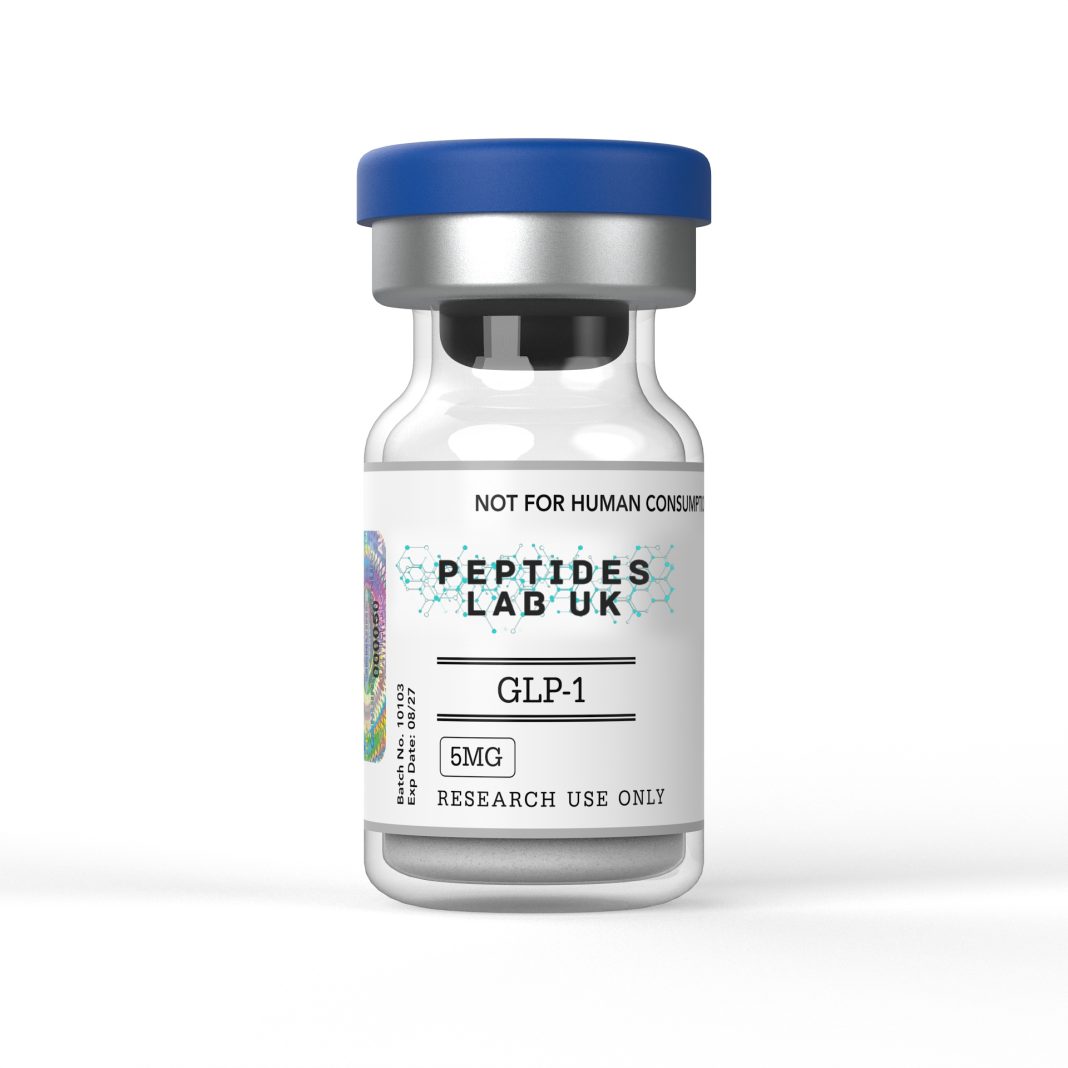
Glucagon-like peptide (GLP-1) is an incretin hormone derived from proteolytic cleavage of the proglucagon precursor protein, synthesised primarily in intestinal L-cells. It acts on the GLP-1 receptor, a class B G-protein-coupled receptor, to modulate glucose-dependent insulin secretion, gastric emptying and central appetite signalling. Within laboratory research, glucagon-like peptide is studied extensively as a model incretin hormone, a receptor-binding reference compound, and a scaffold for structural analogue development aimed at resisting rapid enzymatic degradation.
What Is Glucagon-like Peptide?
Glucagon-like peptide is produced by tissue-specific post-translational cleavage of proglucagon, a 160-amino-acid precursor protein encoded by the glucagon gene. In pancreatic alpha cells, proglucagon is processed by prohormone convertase 2 to yield glucagon, whereas in intestinal L-cells, prohormone convertase 1/3 cleaves the same precursor to yield GLP-1 and the related peptide GLP-2. This tissue-specific processing means that glucagon and GLP-1, despite arising from the same precursor molecule, are produced in different locations and exert largely distinct physiological effects. Proglucagon itself is subject to further tissue-specific cleavage variation, and researchers characterising the peptide fragments produced in different tissues have identified additional minor products alongside the principal glucagon and GLP-1 species, reflecting the complexity of prohormone convertase specificity across cell types.
The active forms of GLP-1 found in circulation are GLP-1(7-37) and GLP-1(7-36)amide, both approximately 30 amino acids in length, with the amidated form representing the majority of the biologically active peptide in human physiology. Structurally, GLP-1 adopts an alpha-helical conformation across much of its length when bound to its receptor, a feature that has informed considerable structural biology work on receptor-ligand interactions. The native peptide has an extremely short circulating half-life, generally cited as under two minutes, because it is rapidly cleaved by the enzyme dipeptidyl peptidase-4 (DPP-4), which removes the N-terminal dipeptide and converts the active hormone into the inactive metabolites GLP-1(9-37) and GLP-1(9-36)amide. This rapid inactivation is one of the central features that has shaped decades of structural analogue research aimed at producing DPP-4-resistant variants for laboratory and pharmacological study.
Beyond the primary active forms, researchers have also catalogued a range of related truncated and extended GLP-1 species, including GLP-1(1-36), GLP-1(1-37) and further N- or C-terminally modified variants, each of which shows differing degrees of receptor affinity and enzymatic stability. This structural diversity has made GLP-1 a frequently used reference scaffold in comparative peptide chemistry research, where a specific truncation or modification is used to isolate the contribution of a given structural region to overall receptor engagement.
Mechanism of Action
GLP-1 exerts its effects by binding to the GLP-1 receptor (GLP-1R), a class B G-protein-coupled receptor expressed on pancreatic beta cells, gastric tissue, vagal afferent neurons and specific regions of the central nervous system, including the hypothalamus and brainstem nuclei. Receptor engagement activates adenylate cyclase, raising intracellular cyclic AMP (cAMP) levels and activating protein kinase A (PKA), which in turn potentiates glucose-stimulated calcium influx in pancreatic beta cells. This cAMP/PKA signalling cascade is central to GLP-1’s most studied action: glucose-dependent stimulation of insulin secretion, meaning the peptide amplifies insulin release only in the presence of elevated glucose rather than causing insulin secretion independent of glucose concentration.
Beyond its pancreatic actions, GLP-1 receptor activation on gastric tissue slows gastric emptying, and receptor engagement on vagal afferent neurons and central nervous system nuclei is associated with appetite-suppressing signalling. Research has also shown that GLP-1 acts on pancreatic alpha cells through a PKA-mediated mechanism that inactivates PKA-dependent calcium channels, reducing calcium influx and consequently supressing glucagon exocytosis from these cells. This dual action, potentiating insulin release from beta cells while suppressing glucagon release from alpha cells, is a key focus of receptor-signalling research into how incretin hormones coordinate glucose homeostasis at the level of the pancreatic islet.
Receptor distribution studies have further shown that GLP-1 receptors are expressed in vascular smooth muscle cells and potentially in vascular endothelial tissue, findings that have prompted a distinct line of cardiometabolic research into how GLP-1 receptor signalling may intersect with vascular and cardiac physiology independent of its glucoregulatory actions. This receptor distribution work relies heavily on immunohistochemistry and receptor-binding assays to confirm expression patterns across tissue types, and findings in some vascular tissues remain an area of ongoing methodological debate, since receptor detection can vary depending on the antibody and assay used.
What the Research Shows
Published research on GLP-1 spans molecular receptor biology, enzymatic degradation kinetics and structural analogue design. A review examining the gut-brain and brain-periphery signalling axes describes how GLP-1 secreted by the intestine can activate vagal afferent signalling toward the brainstem, with subsequent projections to the hypothalamus contributing to systemic metabolic regulation, in addition to the hormone’s direct action on pancreatic beta cells (gut-brain and brain-periphery axes review).
Enzymatic degradation kinetics have also been studied using enteroendocrine cell line models such as STC-1 and GLUTag, which are commonly used to compare basal and stimulated GLP-1 secretion alongside DPP-4 expression and activity. Findings from this line of work indicate that the two cell lines differ meaningfully in their secretory and enzymatic profiles, a consideration relevant to researchers selecting an appropriate in-vitro model for incretin secretion assays.
A widely cited review of GLP-1 receptor agonists and DPP-4 inhibitors summarises the enzymatic basis of GLP-1’s short half-life and outlines the two principal research and drug-development strategies used to circumvent it: developing DPP-4-resistant receptor agonists, and inhibiting the DPP-4 enzyme itself to prolong the half-life of endogenously released GLP-1 (GLP-1 receptor agonists and DPP-4 inhibitors review).
Structural biology research has extended this work further. A study applying molecular modelling and molecular dynamics simulation to GLP-1, DPP-4 and the GLP-1 receptor found that specific amino acid point mutations could confer resistance to DPP-4 cleavage, but that many such mutations simultaneously weakened the mutant peptide’s binding affinity for the GLP-1 receptor, illustrating a persistent structural trade-off between degradation resistance and receptor engagement that continues to inform analogue design research (structural biology and molecular docking study).
A separate line of research has examined the broader molecular and cardiometabolic implications of GLP-1 receptor signalling beyond glucose regulation, drawing on an extensive literature search of PubMed-indexed studies published between 1990 and 2025. This body of work reports that GLP-1 receptor engagement is associated with favourable effects on markers of vascular health and cardiac physiology, and outlines proposed molecular mechanisms linking receptor activation to reduced markers of atherosclerosis and cardiac stress in preclinical models, while also noting that DPP-4 itself has functions beyond GLP-1 degradation, including roles in immune modulation and adipose tissue inflammation that are relevant to interpreting comparative research on GLP-1 receptor agonists and DPP-4 inhibitors.
Research Applications
Within laboratory settings, glucagon-like peptide is used across several established research contexts. Pancreatic beta-cell culture assays represent one of the most common applications, where researchers examine glucose-dependent insulin secretion in response to GLP-1 receptor activation, often alongside comparative work using DPP-4-resistant analogues to isolate receptor-mediated effects from confounding enzymatic degradation. Rodent metabolic models are used to study systemic effects on glucose tolerance, gastric emptying rate and food intake, typically administered to animals under controlled preclinical protocols rather than reflecting any human dosing context.
DPP-4 resistance research constitutes a distinct and active area of study, in which native GLP-1 is used as the reference peptide against which structurally modified analogues are benchmarked for both enzymatic stability and retained receptor affinity. Receptor binding affinity studies, often using radioligand or fluorescence-based binding assays, characterise how structural modifications to the GLP-1 sequence or backbone affect GLP-1 receptor engagement relative to the native hormone. Comparative cell-signalling assays are also used to differentiate native GLP-1 from its DPP-4-resistant analogues in terms of downstream cAMP accumulation and insulin secretion, providing researchers with a functional readout that complements binding-affinity data alone. When selecting a certified GLP-1 research peptide for cell-culture protocols or receptor assays, researchers should confirm that the supplied sequence and amidation state match the specific GLP-1 form required by their experimental design, since GLP-1(7-36)amide and GLP-1(7-37) are not always interchangeable in binding or secretion assays.
Purity, Storage and Handling
Research-grade GLP-1 should be accompanied by a certificate of analysis confirming purity by HPLC, typically at or above 98 percent, together with mass spectrometry confirmation of molecular identity and correct amidation state. Because GLP-1 is a substrate for DPP-4 and related proteases, even trace enzymatic contamination in a poorly handled batch can accelerate degradation independent of storage conditions, making analytical verification particularly important for this peptide relative to more protease-resistant research compounds. UK laboratories sourcing high-purity Glucagon-like peptide for analytical assays should ensure each batch is accompanied by batch-specific documentation rather than a generic product specification, given the sensitivity of downstream binding and secretion assays to purity variation.
Lyophilised GLP-1 should be stored at -20°C, protected from light and moisture, and reconstituted only immediately before use in an experimental protocol, using an appropriate buffer system as specified by the supplier or established laboratory protocol. Once reconstituted, the peptide should be kept refrigerated, used promptly, and protected from repeated freeze-thaw cycling through appropriate aliquoting, since reconstituted GLP-1 is particularly vulnerable to both protease-mediated degradation and physical instability relative to structurally modified, protease-resistant analogues.
Frequently Asked Questions
What is the structural difference between GLP-1(7-36)amide and GLP-1(7-37)?
Both are active, roughly 30-amino-acid forms of GLP-1 produced by cleavage of proglucagon. GLP-1(7-36)amide carries a C-terminal amide group and is the predominant circulating form, while GLP-1(7-37) is a related non-amidated variant; researchers should confirm which form a specific assay or protocol requires.
Why does GLP-1 have such a short stability window in research use?
Native GLP-1 is a direct substrate for the enzyme DPP-4, which cleaves its N-terminal dipeptide and rapidly inactivates the hormone. This enzymatic vulnerability, reflected in a circulating half-life of under two minutes in vivo, also affects in-vitro stability if samples are exposed to protease activity during handling.
Does GLP-1 selectively bind only its own receptor?
GLP-1 is generally selective for the GLP-1 receptor, a class B GPCR distinct from the receptors for glucagon and GIP, though receptor-binding studies continue to characterise cross-reactivity and structural determinants of selectivity among this receptor family, particularly given the structural similarity between these related incretin and pancreatic hormone receptors.
How should research-grade GLP-1 be verified before use in an assay?
Researchers should request a batch-specific certificate of analysis confirming HPLC purity of 98 percent or higher and mass spectrometry confirmation of the correct sequence and amidation state, since even minor structural variation can affect receptor-binding or secretion assay results.
Glucagon-like peptide, as supplied by Peptides Lab UK and comparable UK research suppliers, is intended strictly for in-vitro laboratory research. It is not licensed or intended for human or veterinary use, and nothing in this article should be interpreted as guidance for personal administration.