
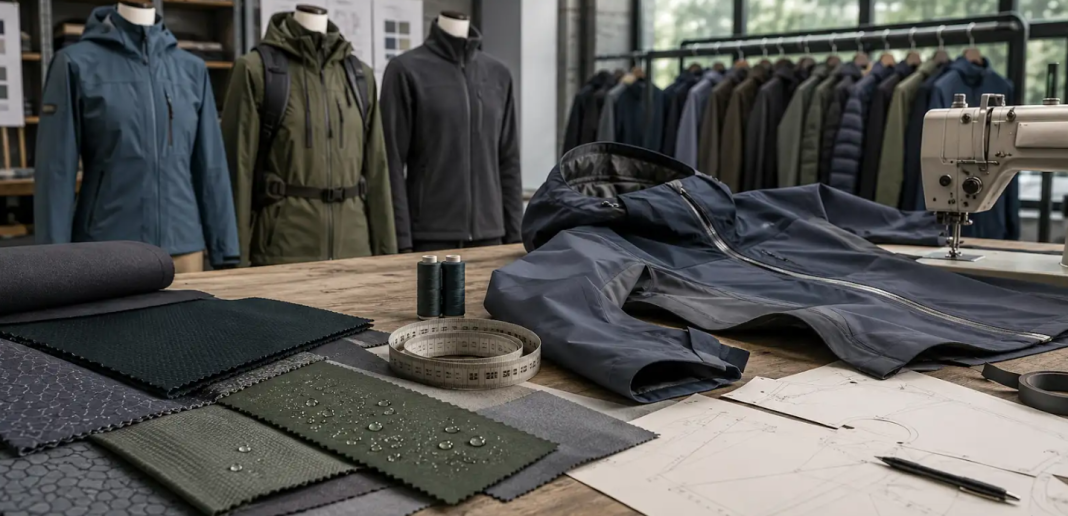
Outdoor clothing may look simple from the outside, but producing reliable performance apparel requires much more than cutting fabric and sewing panels together. A modern outdoor garment must often manage moisture, wind, rain, abrasion, temperature changes, body movement, and repeated use at the same time.
That is why outdoor apparel manufacturing combines textile engineering, garment construction, functional design, testing, and quality control. From choosing the right fabric to sealing critical seams and checking the final garment, each stage affects comfort, durability, and performance.
This article explains how outdoor apparel moves from technical fabric selection to finished production and what manufacturers must consider when creating garments for hiking, camping, skiing, trekking, work, and other outdoor activities.
Why Outdoor Apparel Manufacturing Is Different
Outdoor apparel is generally more technical than ordinary fashion clothing because the garment has to perform in changing environmental conditions.
A casual cotton jacket may only need to look good and fit well. An outdoor jacket may also need to resist wind, repel water, release body heat, protect against abrasion, and allow freedom of movement.
Manufacturers therefore have to balance several factors, including:
- weather protection
- breathability
- moisture management
- insulation
- durability
- stretch
- garment weight
- packability
- comfort
- mobility
A capable outdoor apparel manufacturer must understand how these requirements influence fabric choice, pattern construction, trims, seam design, and finishing methods.
The final specification depends heavily on the activity for which the garment is being developed.
Technical Fabric Selection
Fabric selection is one of the most important decisions in outdoor apparel production.
There is no single fabric suitable for every outdoor application. A lightweight hiking shirt, waterproof shell, fleece layer, insulated jacket, and ski garment all require different textile properties.
Manufacturers usually evaluate fabrics according to performance characteristics rather than appearance alone.
Polyester
Polyester is widely used in outdoor apparel because it is lightweight, durable, quick-drying, and relatively resistant to moisture.
It is commonly found in:
- performance T-shirts
- base layers
- fleece
- jackets
- hiking garments
- linings
Polyester fabrics can also be engineered with moisture-wicking finishes and mechanical stretch.
Nylon
Nylon is often selected where durability and abrasion resistance are priorities.
It is commonly used for:
- shell jackets
- trekking pants
- windbreakers
- technical shorts
- reinforced panels
Lightweight nylon fabrics are useful for packable garments, while heavier constructions can provide stronger protection in demanding environments.
Softshell Fabrics
Softshell materials are designed to provide a balance between protection and flexibility.
They may combine:
- woven polyester or nylon face fabric
- elastane for stretch
- fleece or brushed backing
- water-repellent surface treatment
Softshell garments are particularly useful for hiking, climbing, trekking, and active outdoor use because they allow more movement than many traditional shell fabrics.
Fleece
Fleece is primarily used for insulation.
It provides warmth while remaining relatively lightweight and breathable. Different fleece constructions are available depending on the desired warmth, weight, and texture.
Typical applications include:
- mid-layers
- fleece jackets
- pullovers
- thermal garments
- outdoor vests
Laminated and Coated Fabrics
For stronger weather protection, manufacturers may use laminated or coated fabrics.
These constructions can include a waterproof or breathable membrane bonded to a face fabric.
The purpose is to limit external water penetration while allowing some moisture vapor generated by the body to escape.
Waterproofing and Weather Protection
Water resistance is one of the most important performance requirements in many outdoor garments.
However, “water-resistant” and “waterproof” should not automatically be treated as the same thing.
A water-resistant garment may handle light rain or brief exposure, while a properly engineered waterproof garment requires suitable fabric, seam construction, closures, and finishing.
In waterproof clothing manufacturing, manufacturers may work with laminated fabrics, waterproof membranes, seam sealing, water-resistant zippers, storm flaps, and durable water-repellent finishes.
Durable Water-Repellent Finishes
A DWR finish helps water bead and roll off the fabric surface instead of immediately soaking into it.
It is commonly applied to:
- rain jackets
- ski jackets
- softshell garments
- hiking trousers
- windbreakers
DWR itself does not necessarily make a garment fully waterproof. It usually works as one part of a larger protection system.
Seam Sealing
Even when the fabric is waterproof, needle holes created during sewing can allow water to enter.
For this reason, waterproof garments may require seam tape.
The manufacturer applies seam-sealing tape over stitched seams using specialized equipment. This helps block water penetration through the sewing holes.
Depending on the garment specification, manufacturers may use:
- fully taped seams
- critically taped seams
- partial seam sealing
The correct method depends on the intended level of weather protection.
Breathability and Moisture Management
Outdoor clothing must often protect the wearer from external weather without trapping excessive heat and sweat.
This is where breathability becomes important.
When a person hikes, climbs, skis, or performs physical work outdoors, body heat and moisture increase. If the garment cannot manage that moisture effectively, the wearer may feel wet and uncomfortable even if rain never penetrates the fabric.
Manufacturers use several approaches to improve comfort.
These may include:
- breathable membranes
- moisture-wicking fabrics
- mesh ventilation
- underarm vents
- back ventilation
- lightweight constructions
- quick-drying fibers
The correct solution depends on the activity intensity and expected climate.
Layering Systems Influence Garment Design
Much of modern outdoor clothing is designed around a layering system.
Instead of relying on one heavy garment, users combine multiple layers according to temperature and activity.
Base Layer
The base layer sits directly against the skin.
Its main purpose is moisture management.
Common materials include:
- polyester
- nylon blends
- merino wool
- elastane blends
A good base layer should move moisture away from the body and dry efficiently.
Mid-Layer
The mid-layer provides insulation.
Typical examples include:
- fleece
- lightweight insulated jackets
- thermal pullovers
- synthetic insulation garments
The required insulation level depends on climate and activity.
Outer Shell
The shell protects against wind, rain, and snow.
Shell garments may range from lightweight wind-resistant jackets to fully waterproof hardshells.
Manufacturers have to ensure that the shell is large enough to accommodate layering without creating excessive bulk.
Pattern Development for Outdoor Clothing
Pattern making is another critical stage.
Outdoor garments need to fit the body while allowing movement.
A garment designed only around static body measurements may feel restrictive during hiking, climbing, skiing, or bending.
Manufacturers therefore consider functional movement during pattern development.
Common design adjustments include:
- articulated knees
- articulated elbows
- gusseted crotches
- shaped sleeves
- dropped backs
- ergonomic shoulder seams
- stretch panels
These features can improve mobility without making the entire garment oversized.
Hiking Apparel Requires Activity-Specific Construction
Hiking clothing is a useful example of how garment construction changes according to use.
A hiking garment may experience continuous movement, perspiration, backpack friction, dirt, changing temperatures, and variable weather.
For that reason, a hiking clothing manufacturer may focus on lightweight fabrics, abrasion resistance, stretch, ventilation, secure pockets, reinforced areas, and moisture management.
Hiking pants, for example, may include:
- stretch woven fabric
- articulated knees
- zip pockets
- reinforced seat panels
- gusseted crotches
- adjustable hems
Hiking shirts may instead prioritize ventilation, quick drying, UV protection, and low garment weight.
The product must match the activity rather than simply carry an outdoor appearance.
Garment Components and Trims
Outdoor apparel depends heavily on trims.
Low-quality trims can reduce the performance of an otherwise well-made garment.
Manufacturers therefore select components according to expected use.
Zippers
Outdoor garments may require:
- reverse-coil zippers
- waterproof or water-resistant zippers
- two-way zippers
- heavy-duty zippers
- ventilation zippers
Zipper quality affects both durability and weather protection.
Drawcords and Adjusters
Drawcord systems are often used at:
- hoods
- waistlines
- hems
- cuffs
They allow users to adjust the garment according to weather conditions and body fit.
Hook-and-Loop Closures
Hook-and-loop fasteners are commonly used for cuff adjustments and storm flaps.
Snaps and Buckles
These may appear in outdoor trousers, tactical garments, jackets, and utility clothing.
Each component should be evaluated for durability and ease of use.
Pocket Design Matters
Pockets in outdoor garments are functional elements rather than purely decorative details.
Manufacturers must consider accessibility while the wearer is moving or carrying equipment.
A backpack waist belt, for example, may cover traditional jacket pockets.
Outdoor garment pockets may therefore be placed higher on the body.
Other possibilities include:
- chest pockets
- internal security pockets
- cargo pockets
- sleeve pockets
- mesh storage pockets
- waterproof zip pockets
The placement should reflect how the garment will actually be used.
Insulated Outdoor Garments
Cold-weather outdoor apparel may require insulation.
Manufacturers typically work with synthetic insulation, down, or layered thermal systems.
Synthetic Insulation
Synthetic insulation performs relatively well in damp conditions and is commonly used in jackets designed for varied climates.
It can also be easier to maintain than natural down.
Down Insulation
Down provides excellent warmth relative to its weight.
However, garment construction needs to keep the insulation evenly distributed.
Manufacturers use baffles or quilted compartments to prevent the filling from shifting excessively.
The outer shell also needs to control feather leakage.
Sampling Before Bulk Production
Outdoor apparel should usually be sampled carefully before mass production.
A sample allows the buyer and manufacturer to evaluate more than appearance.
Important checks include:
- fabric performance
- fit
- mobility
- zipper operation
- hood construction
- pocket position
- seam quality
- insulation distribution
- garment weight
- branding placement
For technical garments, multiple sample stages may be necessary.
A development process may include:
prototype sample → fit sample → revised sample → pre-production sample → bulk manufacturing.
Skipping development stages can increase the risk of expensive corrections later.
Performance Testing
Testing requirements vary according to the garment.
Depending on the specification, manufacturers or third-party laboratories may evaluate:
- waterproofness
- breathability
- colorfastness
- abrasion resistance
- tear strength
- dimensional stability
- seam strength
- pilling
- fabric weight
- shrinkage
Brands should determine which tests are necessary based on how the garment will be marketed and used.
Performance claims should ideally be supported by measurable specifications rather than vague descriptions.
Cutting and Production
After fabric approval and sample confirmation, the garment moves into production.
The general sequence includes:
fabric inspection → spreading → cutting → bundling → sewing → seam sealing or special finishing → trimming → inspection → pressing → packing.
Technical garments may require more production steps than ordinary apparel.
For example, a waterproof jacket may require separate operations for:
- shell assembly
- membrane handling
- seam tape application
- waterproof zipper installation
- hood construction
- ventilation sections
- lining attachment
Production planning is therefore important for maintaining consistent quality.
Quality Control During Manufacturing
Quality control should take place throughout production rather than only after the garments are finished.
Factories may inspect:
- incoming fabric
- cutting accuracy
- panel matching
- sewing quality
- measurements
- trim attachment
- seam taping
- logo positioning
- finishing
Final inspection commonly includes measurement checks, workmanship review, labeling verification, and packing inspection.
For performance garments, the quality team may also pay attention to technically sensitive areas such as taped seams, zipper installation, and reinforced stress points.
Branding and Decoration
Outdoor garments can be customized using several branding methods.
Common options include:
- embroidery
- screen printing
- heat-transfer printing
- silicone transfer
- woven patches
- rubber patches
- reflective logos
- sublimation
The correct method depends on the fabric.
For example, heavy embroidery may not be ideal for very lightweight waterproof materials because excessive needle penetration can affect the fabric structure.
Manufacturers should therefore consider both appearance and technical impact before choosing a decoration method.
Sustainable Materials in Outdoor Apparel
Sustainability has become an increasingly important consideration in outdoor clothing.
Brands may explore materials such as:
- recycled polyester
- recycled nylon
- responsibly sourced natural fibers
- lower-impact insulation
- recycled trims
However, using recycled material does not automatically make a garment sustainable.
Durability, repairability, production efficiency, chemical treatments, transportation, and product lifespan also matter.
A garment that lasts for many seasons may create greater practical value than one designed mainly around short-term trends.
Manufacturing Different Outdoor Product Categories
Outdoor apparel manufacturing covers a wide range of garments.
These include:
- hiking jackets
- rainwear
- windbreakers
- softshell jackets
- hardshell jackets
- insulated jackets
- fleece garments
- hiking trousers
- cargo pants
- outdoor shorts
- base layers
- ski clothing
- outdoor vests
Each category requires a different balance of protection, comfort, mobility, durability, and cost.
For that reason, brands should develop specifications according to the intended activity rather than applying the same fabric and construction methods across an entire outdoor collection.
What Brands Should Define Before Manufacturing
The development process becomes much easier when a brand provides clear requirements.
A useful technical brief should define:
- target activity
- expected weather conditions
- target customer
- garment fit
- fabric composition
- fabric weight
- waterproof requirements
- breathability requirements
- insulation level
- stretch requirements
- pocket configuration
- zipper type
- branding method
- colorways
- size range
- order quantity
The more clearly these details are defined, the easier it becomes for manufacturers to recommend suitable materials and construction methods.
Final Thoughts
Outdoor apparel manufacturing is a technical process that connects textile performance with practical garment design.
The final result depends on far more than the fabric alone. Waterproof membranes, seam construction, ventilation, insulation, trims, pattern engineering, testing, and quality control all influence how the garment performs outdoors.
For brands developing hiking, camping, skiing, trekking, rainwear, or other performance collections, the strongest products usually begin with a clear understanding of the end use.
When materials, construction, and manufacturing methods are selected around real outdoor conditions, the finished garment is more likely to provide the durability, protection, comfort, and mobility users expect from modern outdoor clothing.
