Walk into any trade show floor, retail store, or busy restaurant in 2026 and you’ll notice something has shifted. Traditional banners and flat screens no longer turn heads the way they once did. People scroll past them. They glance at a poster and move on. But a glowing, mid-air animation floating above a product display? That stops people cold. It makes them pull out their phones. It makes them ask questions. That’s the power that 3D hologram fans have introduced to the world of modern advertising.
This technology has moved fast. What felt like science fiction just a few years back — a three-dimensional image suspended in open air, visible from multiple angles, requiring no headset or special glasses — is now a practical, affordable tool that businesses of every size are adopting. The question is no longer whether holographic displays are worth it. The question is which one is right for your space and your goals.
What Exactly Is a 3D Hologram Fan?
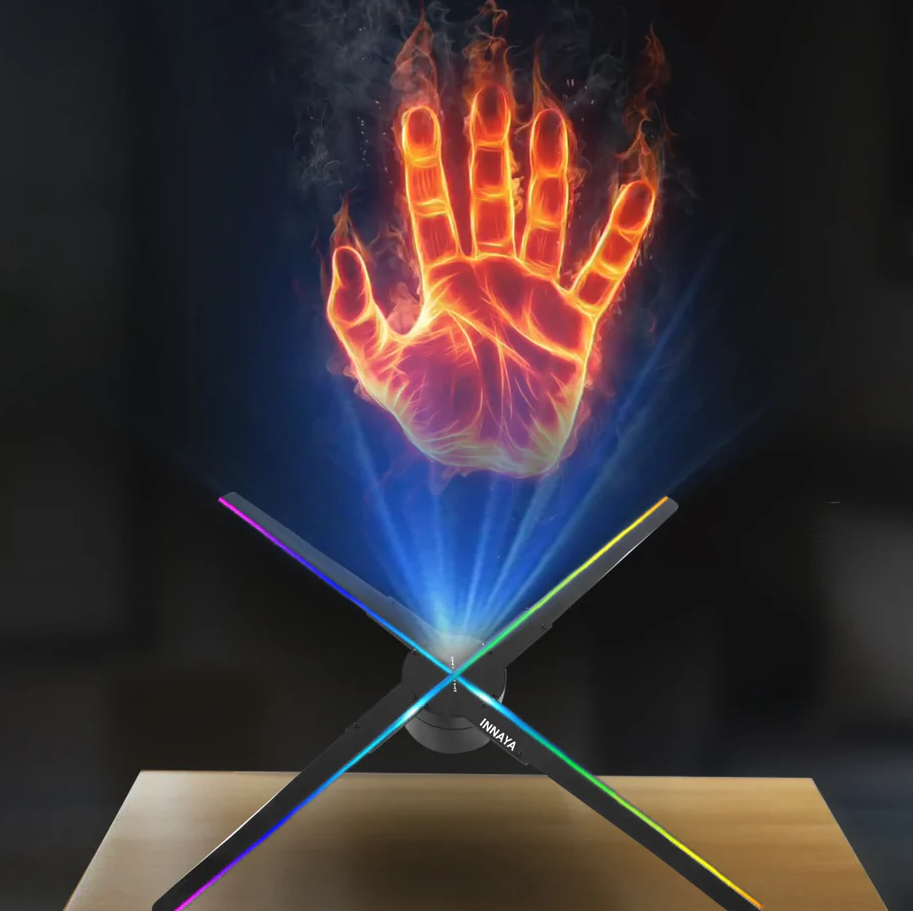
A 3D hologram fan works through a principle called persistence of vision. Spinning LED blades rotate at high speed while displaying images or animations in precise sequence. Because the blades move faster than the human eye can track, the brain stitches the visuals together into what appears to be a floating, three-dimensional object in the air. There’s no smoke. No mirrors. No projection surface. Just light, speed, and clever engineering.
Modern units connect to WiFi, which means you can push content updates remotely from a smartphone or tablet. Upload a new product video, change a promotion, swap a logo — it all happens in real time without anyone needing to physically touch the device. That flexibility matters enormously in fast-moving retail environments where campaigns change weekly and seasonal promotions need to land precisely.
Sizes range from compact 16-inch desk units — the kind you’d set beside a cash register or on a trade show table — all the way up to massive 39-inch and larger installations designed to anchor an entire storefront or exhibition booth. Multi-fan arrays can be synchronized so that several units display one unified image across a wider field, creating an installation that genuinely stops foot traffic.
Who Is Actually Using These Displays?
The short answer is: more industries than you’d expect. Retailers use hologram fans to showcase products in ways that conventional photography simply cannot match. Imagine a running shoe rotating in mid-air, its every angle visible, as shoppers walk past — that’s not a rendering trick, that’s a real-time holographic loop running on a display mounted at eye level near the entrance.
Event producers and experiential marketing agencies have adopted these displays heavily for activations, brand launches, and conferences. A holographic display anchoring a booth draws a crowd in a way that a flat monitor never could. Restaurants and bars use them for menus, atmosphere, and seasonal promotions. Medical and real estate companies use them to present complex visual data — a property layout, an anatomical model — in ways that are immediately intuitive to the viewer.
The applications keep expanding because the technology is genuinely versatile. Any brand with something visual to show has a use case for a hologram fan display.
The INNAYA Lineup: Built for Real Business Use
INNAYA has built a reputation around holographic display technology that actually delivers in demanding commercial settings. Their product line is built around five core models, each sized and spec’d for a different use case, and all sharing the same core features: WiFi app control, a 1-year warranty, and free worldwide shipping.
The H16 is the entry point — a 16-inch compact unit that punches well above its size. It’s the one you’d place on a counter, a shelf, or a table at a trade show where space is tight but impact still matters. At just over $100 with the current discount, it’s the lowest barrier of entry into genuine holographic advertising that exists in the market right now.
The H23 is the mid-range workhorse that INNAYA recommends for most storefront applications. It sits in a comfortable middle ground — large enough to be visible from across a room, compact enough to mount or position without major installation work. This is the one that restaurants, boutique retailers, and small agencies tend to reach for first.
The H39 steps things up considerably. At 39 inches, it commands attention in larger spaces — showrooms, car dealerships, hotel lobbies, exhibition halls. The image quality at this size is striking, and the larger diameter means more detail and greater visibility from distance.
For brands that need maximum presence, the H-PRO Lifesize is a different category entirely. It produces a display that can match human scale, making it suited for fashion, automotive, entertainment, and high-end retail. This is the product that draws a crowd at a launch event. Multi-unit synchronized arrays built around the H-PRO create installations that photograph exceptionally well and generate substantial organic social media content.
Finally, the LS Mini is the desk companion — a smaller, lifestyle-oriented unit designed for personal spaces, product photography setups, creative studios, and smaller-scale brand activations where a full-size commercial unit would be overkill.
Why Holographic Displays Beat Flat Screens for Attention
Neuroscience gives us a pretty clear answer on this one. The human visual system is wired to detect novelty and motion. A flat screen displaying an advertisement is familiar, expected, and therefore easy to filter out. A three-dimensional, glowing object floating in the air with no visible support is none of those things. It violates expectations. It triggers curiosity. It demands a second look.
Marketing professionals who have worked with hologram fan installations in retail report consistent improvements in dwell time — the amount of time a customer spends near a product or display. Longer dwell time correlates directly with higher purchase intent. It’s not just about looking flashy; it’s about keeping someone’s attention long enough for them to actually consider what you’re selling.
That’s a business outcome, not just an aesthetic one. And it’s why brands that invested in custom advertising displays early have seen a meaningful return on that investment as the technology has matured and content creation has become easier.
Content Is What Makes the Difference
Hardware is only half the equation. The content you display on a hologram fan is what determines whether someone stops and engages or glances and walks past. Fortunately, creating content for these displays has become significantly more accessible. Most hologram fans, including the INNAYA lineup, accept standard MP4 video files with transparent backgrounds — meaning any designer or motion graphics artist can produce content without needing specialized holographic software.
The most effective content tends to share certain characteristics. It’s short — typically between 10 and 30 seconds — because the goal is a seamless, looping visual that rewards repeated viewing rather than a narrative that needs to be followed. It features strong contrast and motion that reads clearly against the ambient environment. And it’s specific to the product or message being promoted rather than a generic brand asset repurposed from another format.
INNAYA provides resources and guidance for content creation, and the WiFi app control means that once content is ready, getting it onto the display is a matter of minutes, not hours.
Installation, Placement, and Practical Considerations
One of the genuine advantages of LED hologram fan displays is that installation is far simpler than traditional digital signage. There’s no screen to mount, no bezels to manage, no cable runs to conceal behind walls. A ceiling mount bracket or a display stand is typically all that’s required, and most units include mounting hardware. The visual appeal of the “floating in space” effect actually works in favor of minimal installation — the cleaner the surrounding environment, the more dramatic the display looks.
Ambient lighting is worth considering. While hologram fans perform well under typical commercial lighting conditions, the effect is more pronounced in environments with slightly lower ambient brightness. This is why they work so well as centerpieces at evening events, in dimly lit restaurant environments, or positioned against dark backgrounds in retail settings. During daylight hours in brightly lit spaces, the display still works — it’s just worth knowing that context affects perceived impact.
Sound is another consideration. Hologram fan units produce a moderate hum from the spinning blades. In most commercial settings this is entirely unobtrusive, but it’s worth factoring in for environments where noise is carefully managed, such as libraries, medical waiting rooms, or upscale dining establishments.
The Cost Equation: Are Hologram Fans Worth the Investment?
Compare the cost of a hologram fan display against the alternatives. A professionally printed and installed display banner might run anywhere from a few hundred to several thousand dollars depending on size, and it’s static — change the message and you’re ordering a new banner. A commercial digital screen with installation hardware and an ongoing content management subscription adds up quickly, often to several thousand dollars before the first piece of content is published.
A hologram fan display, particularly in the INNAYA lineup where pricing currently sits at 50% off list price, offers a genuinely competitive cost point. The H16 starts at $107.90. The H39 at $719.40 delivers a display that would easily command five figures if it were commissioned as a custom installation through a traditional AV integrator. The content can be changed remotely and at no additional cost. The warranty covers you for the first year, and shipping is included worldwide.
For small businesses, the math is compelling at the entry level. For agencies and enterprise brands building out event fleets or permanent retail installations, the per-unit cost at scale makes holographic advertising economically rational in a way that it wasn’t even two or three years ago.
What to Look For When Buying a 3D Hologram Fan
Not all hologram fans are created equal, and it’s worth knowing what separates a well-engineered product from something that looks similar in product photos but disappoints in person. Resolution matters — measured in the number of LEDs per blade and the resulting visual clarity of the projected image. Rotation speed matters because it directly affects how smooth and three-dimensional the image appears. Build quality matters because these devices are running continuously in commercial environments, often for many hours per day.
WiFi connectivity, remote content management, and sync capability for multi-unit setups are features that separate professional-grade units from consumer novelty products. So is the quality of after-sale support — firmware updates, content assistance, and warranty service are all part of the total ownership experience.
INNAYA has built their product line specifically for commercial use cases, which is reflected in how the hardware is engineered and how their support is structured. The models in their lineup aren’t the cheapest options on the market, but they sit at a price point that reflects genuine build quality and ongoing serviceability rather than a race to the bottom on unit cost.
The Bigger Picture: Where This Technology Is Going
The trajectory of holographic display technology points toward wider adoption across more categories and price points, better content creation tools, and increasingly sophisticated multi-unit installations that push the boundary of what’s possible in a commercial environment. Retail, events, healthcare, real estate, entertainment — every sector with a visual storytelling need has a potential use case.
For businesses looking at this technology today, the timing is genuinely good. The price point has reached a level where holographic displays are accessible to businesses of real variety, not just enterprise brands with large budgets. The content creation ecosystem has matured enough that any brand with a decent design team or agency relationship can produce holographic content without prohibitive cost or lead time.
The brands that move early on technology that genuinely changes consumer attention tend to benefit disproportionately from the novelty advantage before it becomes the expected baseline. Holographic advertising is at that inflection point right now. Getting a display into your space, testing it, and building the content library gives you a head start that compounds as the technology becomes more widespread.
Whether you’re a boutique retailer looking for a compact unit for your counter, an event agency building out a display fleet, or a brand manager scouting the next thing that will make your activation stand out on social media, the holographic display category has an option that fits. The question is simply which one, and INNAYA makes that question easier to answer with a clearly structured lineup, competitive pricing, and a support structure built around commercial use.